
What to post on LinkedIn (if you want leads, not likes)
Jun 24, 2026
Most advice on what to post on LinkedIn is designed to make a number go up. Followers. Views. Impressions. Likes. The kind of growth that feels like progress.
I know how to go viral on LinkedIn. I've done it. The trick that always works for me is to post about politics. Tens of thousands of views, hundreds of likes, people I've never met arguing in my notifications for days.
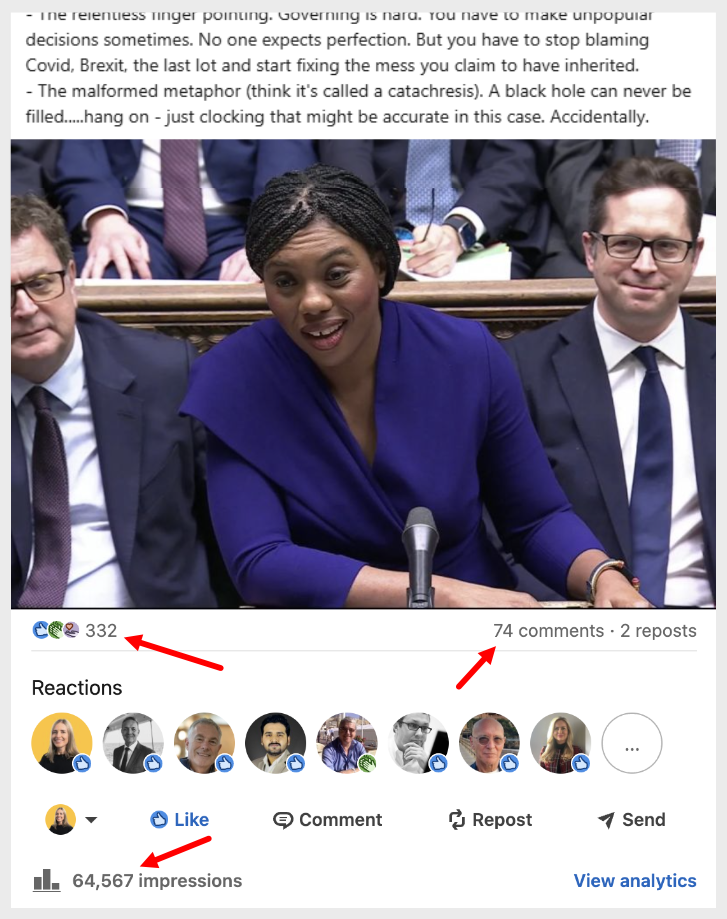
Leads from those posts? None. Because the people arguing about politics in my comments were never going my customers.
So now I've checked my ego and let go of the goal of going viral. Because I want to use LinkedIn for lead gen. And now that I'm clear on what I'm posting for, I can be much more strategic about what I post. Because I know that if you want to use LinkedIn for lead gen, then most of the popular advice is sending you the wrong way.
So, what should you post on LinkedIn to get leads?
Post for the room, not the crowd.
You don't need sixty-four thousand people to see your post. You need the five people who run the kind of business you can help. A post that reaches five of the right people beats one that reaches all of the wrong ones.
When you make peace with that, you stop chasing the topics that get strangers worked up, and you start posting the things your actual buyers stop scrolling for. The politics posts went wide. They just went wide with the wrong audience.
So the first question isn't "what will get me views?" It's "what would make my next customer stop and think: this person gets it?"
What kind of posts actually generate leads?
The posts that generate leads on LinkedIn are the posts only you could have written.
Go and look at most LinkedIn feeds. The same posts, over and over. Five tips for productivity. Why authenticity matters. A list of trends for the year ahead. All reasonable. All interchangeable. All now easily produced by AI in seconds.
If a machine could have written your post, the post is worthless. Not because the writing is bad, but because there's an infinite supply of it, and no reason for anyone to read yours instead of the next one.
So post the things with your fingerprints on them:
- Your opinions. The views you've formed over years of doing the work (including the ones not everyone agrees with).
- Your data. What you've seen in your own business, your own results, your own experiments. Nobody else has it.
- Your stories. What actually happened when you did the thing, including the parts that didn't go to plan.
This is also how you sell without sounding like you're selling. You're not pitching. You're showing what you know, and letting the right person work out that they need you.
What posts will get you taken seriously by decision-makers?
Post about the same thing, over and over, until you're known for it.
The people who build an audience that buys are known for one thing. When a decision-maker thinks of their problem, they think of you, because you're the person who is always talking about exactly that.
The algorithm can work for you or against you. The best way to get it working for you is to drone on about the same subject, so it never gets confused about what you're about. Post about one thing, and it learns who your people are and sends your posts to more of them. Post about six, and it can't tell who you're for, so it shows you to nobody.
So pick the subject your business depends on, and stay there. So that when a decision-maker encounters you, they know in three seconds what you do and whether they need you.
What post formats work best on LinkedIn?
The format that works best is whichever one LinkedIn is rewarding this month, so keep half an eye on it.
As things stand, documents and carousels are pulling far better numbers than anything else, and native video is strong. Plain text still works though if the writing is good enough.
Posts whose only job is to push someone off LinkedIn to your webinar or your blog get buried, because the platform doesn't want people leaving.
If you're sharing a case study or a client result, a document or carousel is usually the best home for it. It holds attention while you walk through what happened, slide by slide, and people save it to come back to.
But the format is the wrapper, not the substance. A beautiful carousel about nothing is still nothing. Get the thing worth saying right first, then put it in whatever format is currently travelling furthest.
How do you end a LinkedIn post without sounding salesy?
Ideally, you don't be salesy. Instead, you are interesting enough that people naturally look at your profile, where they find your featured links and step into your ecosystem on their own.
But if you must have a call to action, keep it light. Ask a question you (genuinely) want the answer to. Or offer to send something (genuinely) useful if they comment or message you. Give them a (genuine) reason to carry on the conversation, not a reason to buy.
The test is simple. Does this ending give the right person an easy way to put their hand up? If it does, it's working. If it reads like a closing line from a sales call, cut it and don't ask for anything.
Not every post needs an ask.
Should you say things people disagree with on LinkedIn?
Yes, Snowflake*. Toughen up. The disagreement is the point!
Most people want their posts liked. The comments filled with "great post". The polite nods. It feels like success. It's almost worthless. "Great post" is a nod on the way past. The algorithm knows the difference between a tap and someone stopping to write three paragraphs about why you're wrong.
So take a position someone could reasonably disagree with. And when they do, don't get defensive. Engage. The person arguing with you in the comments is doing more for your reach than the ten who agreed.
This is also why I'd not bother with polls. People will tell you polls are great for engagement, and they are, if engagement is all you want. They pull a lot of clicks and almost no leads. A poll is the crowd again. A real opinion, that the right person agrees or disagrees with, is the room.
Should you comment as much as you post on LinkedIn?
Yes, and when your audience is small, the comments do more than the posts.
A (genuinely) thoughtful comment (by which I do not mean a comment that sounds thoughtful, because you ask Claude to write it in the style of a thoughtful person), on the right post puts you in front of someone else's whole audience. Everyone reading it sees your name, your headline, your point of view. While your own following is still small, that borrowed reach is worth more than anything you publish on your own page.
So find the conversations your buyers are already in, and add something worth reading. Not "great post". A real thought, a counterpoint, a bit of your own experience. Something that makes people click your name to find out who just said that.
Posting is half the job. Commenting is the other half. (There are actually four more halves, but I can't make that maths work).
The test before you post on LinkedIn
Before anything goes up, ask two questions. Would my buyer care? And could only I have written this?
If the answer to both is yes, post it. If a machine could have written it, or your buyer wouldn't care, leave it in drafts.
That's what to post on LinkedIn if you want leads. Not the posts that get you noticed. The posts that get you chosen.
If you want the whole system for turning LinkedIn into leads, my LinkedIn for leads mini course walks through it step by step.
*Had to share Claude’s witty attempt to assist me with that insult. Claude suggested I write this: “A snowflake toughens up by getting compressed and frozen harder; pressure and cold turn it to ice, then to a glacier that carves through rock. The thing that would destroy a delicate snowflake is exactly what makes it formidable.”
Written by Heather Baker, founder of the AI Edit and reformed viral LinkedIn poster.