
GEO vs SEO: which should B2B businesses invest in?
Aug 20, 2026
Half the search industry rebranded as GEO agencies this year. The buyers didn't move.
For B2B businesses making the choice between GEO vs SEO right now, the answer is still SEO. Search engines are still the single biggest channel driving purchases, and in our latest survey they grew. AI chatbots have held steady at roughly a quarter of buyers - in the same place they were four months ago. Generative engine optimisation is a discipline worth preparing for, but nobody has proven how to do it yet, and the money you move into it comes out of the one channel that is still working.
What GEO actually is
Generative engine optimisation is the practice of getting your business to show up inside AI-generated answers. When someone asks ChatGPT, Claude, Gemini or Perplexity to recommend a supplier, GEO is the work that decides whether your name appears.
The logic is sound. If buyers stop typing queries into Google and start asking chatbots instead, then being visible inside those answers becomes the whole B2B lead generation ballgame. Plenty of agencies have built their 2026 positioning on exactly that premise.
The premise is reasonable. The timing not so much
What our data says about search and AI chatbots
In April we asked a panel of people where they had found the things they bought that week. We ran the same question again in August.
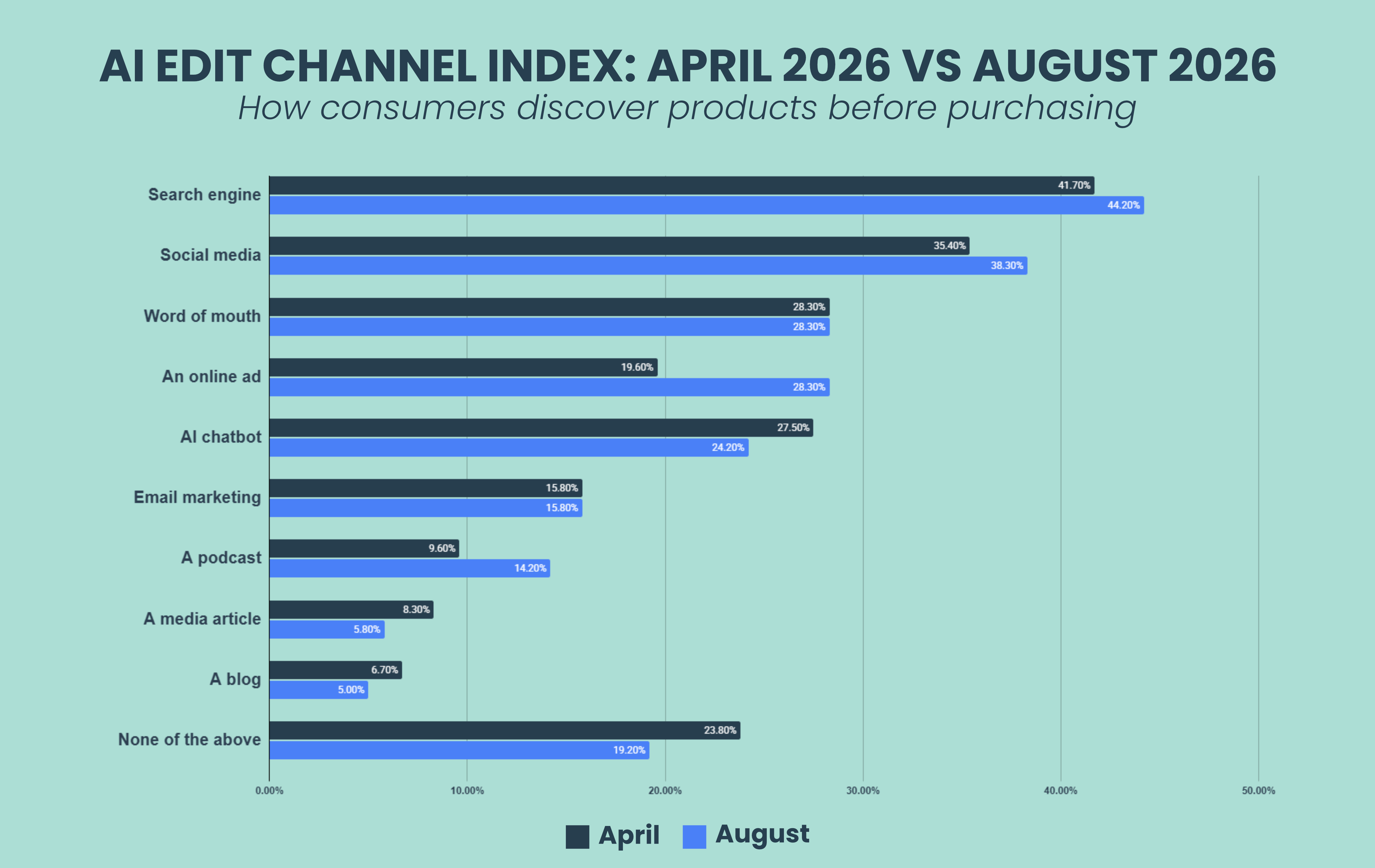
Search came out on top again: 44.2% had bought something they had found via an online search in the last week - with a wider lead over second place than it had in the spring. AI chatbots sat at 24.2%, statistically unchanged from April.
Four months is a long time in this market. Between those two surveys the model releases kept coming, the AI answer boxes got bigger, and the trade press ran a fresh obituary for search roughly every fortnight. None of it showed up in what people bought.
Why GEO has not paid off yet
Two potential explanations:
- Buyers do not trust chatbot recommendations enough to act on them. They ask, they read, and then they go and check somewhere else before they spend.
- Businesses have not worked out how to capture the demand. People are asking. The answers are being generated. The commercial machinery for turning that into a sale has not been built.
My money is on both. AI visibility is a young discipline. There are guides everywhere, most of them written by people who have been at it for only a few months. There is no proven method, no agreed measurement, and no consensus on what a result even looks like. When an entire field is publishing frameworks nobody has tested at scale, that suggests that opportunity has not been cracked.
It will be cracked. Probably soon. But you cannot fund a channel on the promise that somebody will eventually figure it out.
What this means for B2B businesses specifically
Our panel was consumers, not procurement teams. Nobody in it was signing off a six-figure contract on the strength of an AI answer.
That works in favour of the argument rather than against it. B2B has always lagged consumer behaviour on new channels, by years rather than months. Buying decisions involve more people, more scrutiny and more risk. If general buyers have not yet started converting through chatbots on low-stakes purchases, your buyers are not doing it on high-stakes ones.
The direction of travel is the useful part. Consumer behaviour is the leading indicator, and right now the indicator says search.
Where to put your money
Three things.
- Keep SEO as the priority. It is the biggest purchase-driving channel in both waves of our data, and it grew while everyone was writing it off. Cutting it because the industry has moved on to something newer is a fashion decision.
- Build the GEO foundations now, and fund them from growth rather than from your search budget. Structured content, clear answers to the questions your buyers actually ask, pages that can be quoted rather than just ranked. Most of that work improves your search performance anyway, which makes it a low-risk bet either way.
- Measure both, and let the numbers decide when to shift the balance. The moment AI chatbots start converting properly, you will see it in your own analytics before you see it in anyone's prediction. Building lead generation that responds to evidence rather than headlines is the entire point of proper lead gen strategy.
Common questions about GEO vs SEO
Is SEO dead?
No. In our August survey, 44.2% of UK adults had bought something in the previous week that they found through a search engine. That is more than any other channel, and up from 41.7% in April.
Should I stop doing SEO and switch to GEO?
No. Switch and you leave the largest purchase-driving channel to fund one that has not yet demonstrated a return. Run both, weighted towards search.
When will GEO be worth serious investment?
When AI chatbots start converting at a rate that justifies it. Watch your own analytics rather than the commentary.
Methodology
We surveyed a panel of 120 UK adults on 17 August 2026. Respondents were representative of the general adult population. Figures show the percentage of all 120 respondents who selected each channel.
Heather Baker is the founder of The AI Edit, a company that has gone from complete unknown to ranking on page one for five key search terms in under four months. SEO works people. It works.