
Is SEO dead? Our data says no
Apr 23, 2026
Everyone has an opinion on whether SEO is dead. Most of them come from people selling SEO services, or from people selling alternatives to SEO services.
So we ran our own survey. We asked a panel of 240 people in the UK and the US a simple question: in the past week, have you bought something you found through any of these channels? Search engines. Social media. AI chatbots. Word of mouth. Email. Ads. Podcasts. Media. Blogs.
The data doesn't quite match the narrative.
What the data says about where people find things to buy
We asked people to tell us, from a list of nine channels, which ones they had used to find something they bought in the past week. They could pick as many as applied. Here's how it came out.
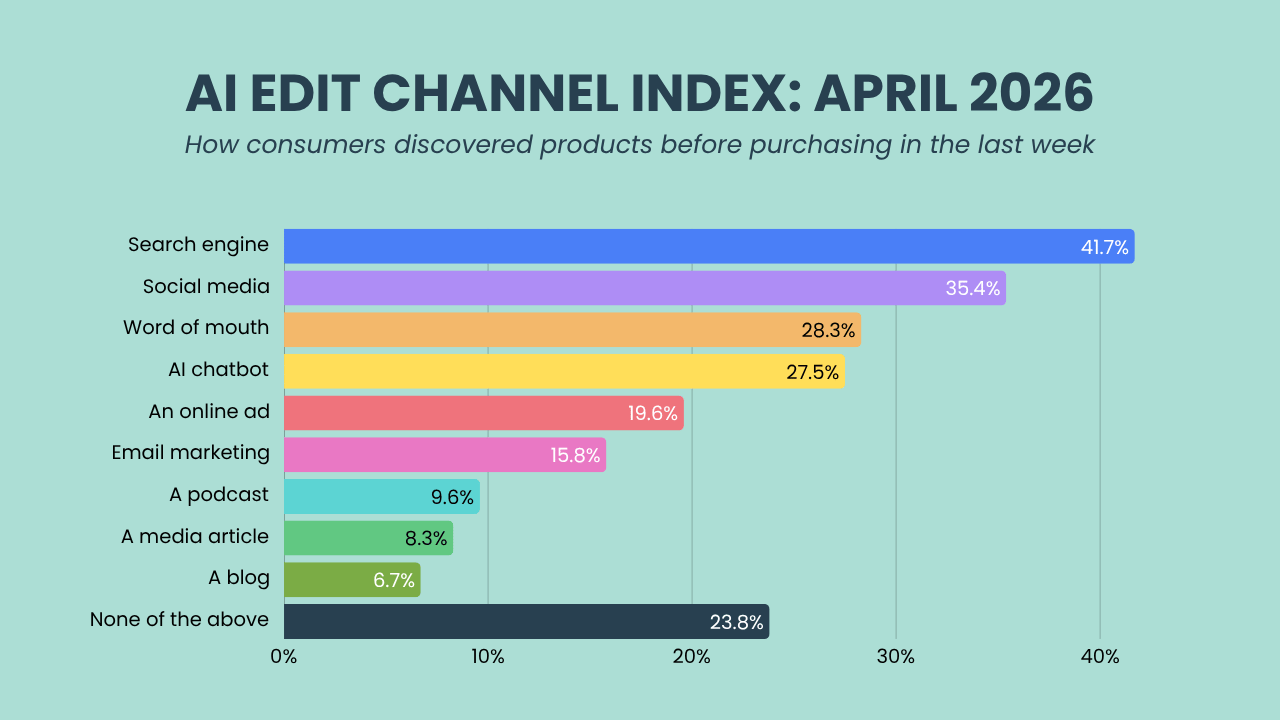
Three things jump out. Search is still the biggest purchase-driving channel by some distance. AI chatbots are already the fourth-biggest, beating online ads, email, podcasts, articles, and blogs. And no single channel was used by more than half the people we asked. The distribution was quite wide.
SEO isn't dead. It's #1.
Search engines are still the single biggest channel driving purchases. 41.7% of the people we asked had bought something in the past week that they had found through Google or Bing. More than social media. More than word of mouth. More than AI chatbots. More than any other channel on the list.
That's in spite of two years of headlines telling us SEO is over. AI Overviews eating the top of the search results page. Zero-click searches. ChatGPT replacing Google. Every SEO agency in the world repositioning as a GEO agency. And yet people are still searching. They're still clicking. They're still buying from what they find.
If your business has quietly pulled back on SEO because everyone told you it was dying, you've pulled back on the biggest purchase-driving channel there is.
AI chatbots are already the fourth-biggest purchase channel
27.5% of the people we asked had bought something in the past week that they found via an AI chatbot. ChatGPT. Claude. Gemini. Perplexity. Copilot. More than one in four.
Three years ago, that number was zero. The tools didn't exist at any meaningful scale. Now they're driving more purchases than online ads, email marketing, podcasts, media coverage, and blogs. Combined.
Every business we speak to is still deciding whether to take LLMO seriously. Whether it's real yet. Whether it's worth the investment. The answer is in the data. A quarter of consumers are already buying through AI chatbots. Your buyers are in that quarter. If you are not showing up when those searches happen, you have a hole in your lead gen.
No single channel wins
The top four channels in our survey - search, social media, word of mouth, AI chatbots - were each used by between 28% and 42% of the people we asked. None of them were used by a majority. The drop-off between the biggest channel and the fourth biggest was only 14 percentage points. The drop-off between the fourth biggest and the fifth was eight.
Put another way: there is no single tap you can turn on for leads and sales. There is no channel that, on its own, covers most of your market. There is no shortcut to generating leads and making sales.
This matters because most businesses are still trying to find that one channel. They pour everything into LinkedIn, or everything into SEO, or everything into paid social, and then they wonder why their lead generation feels fragile. It feels fragile because it is fragile. Relying on one channel in a world where the biggest channel only reaches 42% of buyers is a strategic error.
A sustainable lead generation strategy - the kind that holds up when algorithms change and platforms shift - works across several channels at once. Not because more is better, but because the data says purchases come from everywhere.
What this data means for your lead gen strategy
Three things.
1. Keep investing in SEO. It's still the biggest purchase-driving channel in the data. Cutting it because everyone says it's dying is a fashion decision, not a strategic one.
2. Take LLMO seriously now. AI chatbots are already driving more purchases than online ads, email marketing, podcasts, media coverage, and blogs. This isn't a future opportunity. It's a present one. If you're not in the consideration set when someone asks ChatGPT or Claude or Gemini for a recommendation, you're invisible to more than a quarter of buyers.
3. Review your channel mix against the data, not your assumptions. Most businesses over-invest in one or two channels and ignore the rest. The data suggests that's the wrong shape. A sustainable lead generation strategy works across the channels where purchases actually happen, in proportion to where they actually happen.
Methodology
We surveyed a panel of 240 adults on 10 April 2026: 120 in the United Kingdom and 120 in the United States. Respondents were representative of the general adult population and results were stratified and weighted to reflect national demographics.
Figures in this piece show the combined UK and US response, calculated as the percentage of all 240 respondents who selected each channel.
The next AI Edit Channel Index will be published in May 2026.
About the author
Heather Baker is the founder of The AI Edit. She has been nominated for 26 awards across AI, marketing, lead gen, sales, and business growth, and has won 14 of them (so far).