
How to make your website AI friendly
Sep 02, 2026
Your buyers are asking AI tools about the thing you sell. Some of them will get an answer that names a business like yours. The question is whether it names you.
That happens or it does not for reasons you partly control, and most of them are not especially technical.
An AI tool answering a question is looking for pages it can use. It wants a page that clearly answers what was asked, in a structure it can read without guessing, from a business whose details are stated rather than inferred. Meet those three conditions and you are a page it can quote. Miss them and it goes somewhere else, which usually means a competitor.
There is a version of this conversation that gets very technical very quickly. This is not it. Three things matter when it comes to making your website AI friendly (and none of them requires you to write code).
What questions are your buyers asking AI tools?
People do not talk to AI tools the way they talk to Google.
Nobody types "lead generation consultant London" into ChatGPT. They type something closer to: “Should you use a pay per lead agency in the UK?” or “What’s the most cost-effective way to get B2B leads?”
Longer. Conversational. A situation rather than a phrase.
You cannot see this data. Nobody can. There is no volume figure for what people type into ChatGPT, because it is private and phrased a thousand different ways. Anyone selling you prompt volume data is selling you something they made up.
What you can do is build a sensible sample. Describe your business, your customer and what you sell to an AI tool, then ask it for fifty questions a real buyer would ask before buying from you. Tell it to phrase them the way a person would type them, not as search terms. Then run your main keywords through Answer The Public, which surfaces the question-shaped searches around a topic.
Put the two together and clean the list up. Anything that reads like stuffed keywords rather than a genuine question, drop it or rewrite it.
Then use it. Take the questions relevant to each page and answer them on that page, in the words they were asked. Sometimes inside the copy. Sometimes as a section of questions at the bottom.
That’s it. A page containing a clear answer to a question, phrased the way people ask it, is a page an AI can use. A page that dances around the same subject in your own preferred language is not.
Can a machine read the structure of your page?
A person reading your page can tell what is a heading and what is not, because headings look different. A machine cannot see the page. It reads the code underneath, and if that code does not mark your headings as headings, they are just text.
So the structure has to be real, not visual.
One H1 (top-level heading) per page. The main heading at the top. Containing the phrase the page is built for. H2s for section titles. H3s for anything inside a section. In that order, without skipping levels because a smaller size looked better.
Then make the headings carry meaning on their own. Someone should be able to scan down the page and come away knowing what it says, and a machine reads something close to that. Cryptic headings cost you. One-word headings cost you. Headings that only make sense once you have read the paragraph underneath cost you. Name the question or state the point instead. "How the process for auditing your website works." "What it costs to build a lead gen engine." "Who this lead gen method is for." Boring and clear beats clever and vague.
Six more things, on every page, each taking a minute.
- The page title, which is the clickable headline in search results and the text in the browser tab. Not the same thing as the heading on your page, though a lot of website builders will use one for the other if you let them. Keyword near the front, around sixty characters.
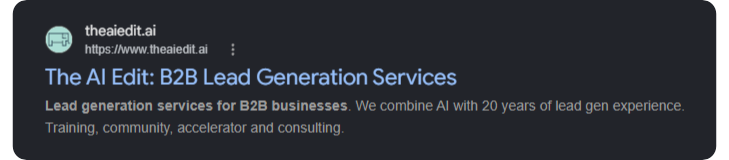
- The meta description, the couple of lines underneath the title in results. Around 150 characters, saying what the page offers and giving a reason to click. Leave it blank and Google picks a sentence from your page, and it will not pick the one you would have chosen.
- The web address. Short, readable, words with hyphens between them. /lead-generation-consulting works. /page-id-4471 does not.
- And alt text on every image, which is a short plain description of what the picture shows. A photo of your team is "the team at a client workshop", not a list of keywords.
- Show who wrote the page and when it was last updated. Both Google and the AI tools are working out whether a page comes from someone who knows the subject, and an unsigned page from nobody in particular is a weaker signal than one with a named human behind it. It matters to your reader too. A page last updated four years ago tells them something.
- And link your pages to each other inside the sentences where it makes sense. Links tell a machine how your pages relate, which helps it work out what your site as a whole is about. Not a list of related links dumped at the bottom that nobody reads.
Does a machine have to guess what your business does?
This part has the most direct effect on whether you get named in an answer.
Schema is a piece of code that sits behind your page and describes the type of content the page contains in a format machines read directly.
Your page might say you are a lead generation consultancy, that you charge from a certain amount, that you have a five star rating. A person reads that and understands it. A machine is inferring it from the words, and it might get it wrong.
Schema removes the guesswork. It states plainly: this is an organisation, here is its name, its location, its services, its rating. Same information, in a format that leaves no ambiguity.
Two reasons it is worth having. It is where the extra detail in Google results comes from, the star ratings, the prices, the expandable questions, the opening hours. A result with those takes up more space and gets more clicks than a plain one. And when an AI tool is deciding what your business does and whether to name it in an answer, stated data is worth a great deal more than data it has to work out for itself.
There are hundreds of schema types. These are the ones a B2B site needs.
- Organisation on your homepage, with your name, logo, contact details and social profiles.
- LocalBusiness instead, if you have premises people can visit or an area you serve.
- Service on each service page.
- Person on your about page and anywhere you have an author bio.
- FAQPage wherever you have a questions section, which is the one most likely to earn you extra space in the results.
- BlogPosting on articles, with the author, the date and the image.
- And Review or AggregateRating on testimonials.
You do not need to write this yourself. Give an AI tool the address of a page, tell it what the page is for, and ask which schema types it should have and to generate the code (then verify because AI hallucinates). It will produce it and explain what each part does if you want to know. Then test it with Google's Rich Results Test, which tells you what Google can see and flags anything broken.
Then send it to whoever looks after your site and ask them to add it. It is a straightforward job and they will know how.
None of this AI visibility stuff is a technical project
Read back over those three sections and notice what is not in them.
There is no tool to buy. There is no agency to hire. The one piece of actual code is generated for you in a minute and handed to whoever looks after your site.
What there is: knowing what your buyers are asking, answering it in their words, structuring the page so the answer is findable, and stating plainly who you are.
Which is the same thing as writing a good page for a person. The machine wants clear structure, plain writing and a direct answer. So does your buyer. Write well for the reader and you are most of the way there for both.
The businesses getting named in AI answers are not the ones with the cleverest technical setup. They are the ones whose pages actually answer the question.
I have made a course that takes you through building a website that generates leads, and this is part of it. It covers the questions to answer before you start, the pages you need, the research behind them, how to write each one, the technical work, and the monthly hour that keeps it working.
Heather Baker is the founder of The AI Edit, a company that has gone from complete unknown to ranking on page one for five key search terms in under four months. SEO works people. It works.