How to improve your LinkedIn profile to attract new business
Jun 30, 2026
Most people improve their LinkedIn profile by polishing it like a CV. That is a mistake. Your profile is not a CV. It is a landing page, and its job is to turn a curious visitor into a lead.
That’s because long before anyone buys from you, before they even decide whether to connect, they look at your profile. Someone reads your comment, finds it interesting, and clicks your name. Someone gets your connection request and checks you out before accepting. Someone comes across your post, and they click through to find more. Every move you make on LinkedIn sends people back to one place, and that place is either working for you or against you.
A CV is a record of where you have been, written for a recruiter. A landing page has one job: take someone who just became mildly curious and give them a reason to stick around, follow you, and eventually do business with you. Improve the five parts below and your LinkedIn profile starts doing that job around the clock.
Your headline: say who you help, not what you are called
Your headline is the most valuable strip of space on your profile. It follows you everywhere. Every comment you leave, every connection request you send, every time your name appears in a feed, your headline sits right underneath it.
The mistake is using it as a name badge. "Head of Business Development at Some Company" tells people what to call you and nothing about whether they need you. Worse, a job title signals one thing above all: this person is going to sell to me. Guards go up.
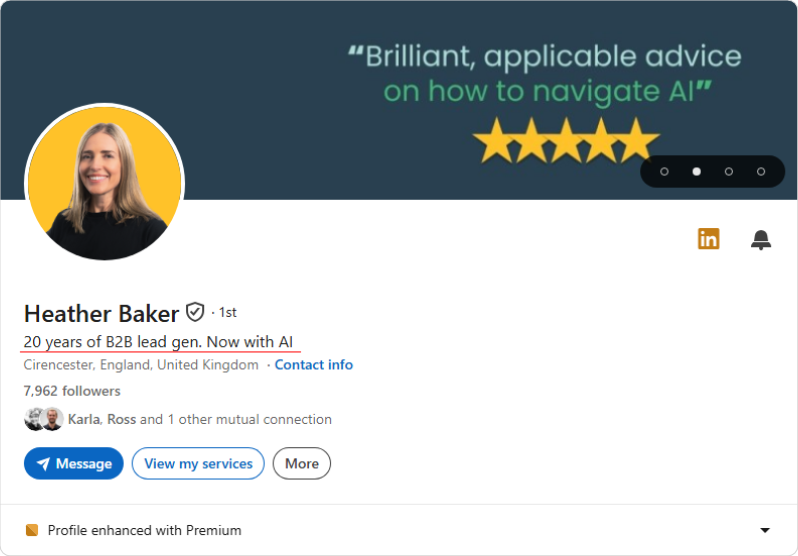
Your headline should make the right person think, I need to know more about this person. So tell them who you help and how. A simple formula works: your role, then a line on the value people get from you. Not "Head of Business Development" but something like "20 years of B2B lead gen. Now with AI." Make it yours, but keep it serious. Cheesy costs you more credibility than a boring job title ever would.
Your photo: make the first handshake a good one
People decide how they feel about you before they read a single word. They feel it from your photo, in about a tenth of a second, and most of that judgement happens before they are even aware of it.
The mistakes are familiar. The car selfie with the seatbelt still on. The shot taken from across the room. The one so dark you are mostly a silhouette. The logo where a face should be. Or no photo at all, which on LinkedIn reads as either a bot or someone with something to hide.
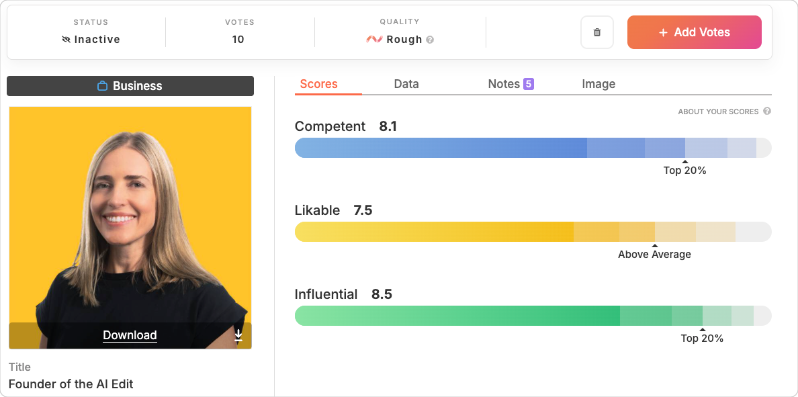
What you want is simple. A clear shot of your face, friendly and approachable. Someone should glance at it and think, I would happily have a coffee with that person. It does not need an expensive shoot. It needs to be well lit, in focus, and warm. If you want to know how your photo actually lands rather than how you hope it lands, a tool called Photofeeler has real people rate it on how likeable, competent, and influential you come across. It is the difference between guessing and knowing.
Your banner: use the billboard
The banner is the biggest piece of visual space on your profile, so don’t waste it. The default LinkedIn blue. A stock skyline. A landscape that says nothing about anything.
That space is a billboard. It is the first thing someone sees when they land on your profile, before they read a word. Treat it like the top of a landing page, because that is what it is. A headline that sums up what you do and who for. A real testimonial from a real client, so the proof is working before you have said anything yourself. A call to action that points to whatever you want people to do next.
Empty banner, empty opportunity. Fill it.
Your About section: drop the modesty and write like a human
People actually read this one. When someone is deciding whether you are worth following, connecting with, or buying from, this is where they go to make up their mind. So it has to earn the read.
Two mistakes kill most About sections. The first is writing it like a CV: third person, dry, a list of roles and dates. "Jane is a results-driven professional with fifteen years of experience." Nobody talks like that and nobody wants to read it. Write it yourself, in the first person, in your own voice, the way you would explain what you do to someone interesting at an event.
The second mistake is misplaced modesty. This is not the place to be humble. It is the place to tell people what you have done, who you have done it for, and why that makes you worth their attention. Your wins. Your numbers. The names. The proof. People cannot decide to trust you with what they do not know. So: your story, what you do now, the proof that you are good at it, and a clear line on what to do next. Keep it tight. Nobody is reading an essay.
Your featured section: the one place a visit becomes a lead
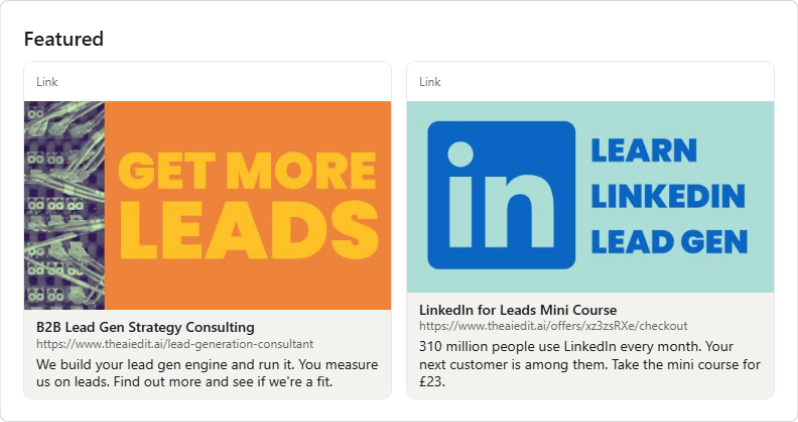
This is one of the most powerful parts of your profile, and you might not know it is there. The featured section sits near the top and lets you pin things people can click. Not just look at. Click. That makes it the one place where a curious visitor can actually become a lead. Everything else tells people who you are. This part gives them somewhere to go.
Be deliberate. Two or three things, no more. Any more and you have handed people a menu instead of a decision. Pin what matters most: your newsletter, so people can opt in and you keep showing up in their inbox. Something that points to what you sell. Ideally, at least one thing that captures their details, so a profile visit turns into a name you can follow up with. Some of this sits behind LinkedIn Premium, and for the ability to turn a visit into a captured lead, it pays for itself quickly.
Don't forget keywords…
Two more things before you are done.
First, keywords. LinkedIn has its own search, and people use it to find suppliers, partners, and experts. The words in your headline and About section are part of how LinkedIn decides who to show. So use the language your buyers actually use to describe the problem you solve. Not jargon only you understand, the plain words a client would type.
…or the rest of your profile
Second, the rest of the profile still needs filling in. Your work history, your experience, all the usual parts. A few quick rules. Focus on what you achieved, not just what you were responsible for, because anyone can list duties and achievements are what make someone pay attention. Lean into the work you loved, since that is the work you want more of. Write it in the same voice as your About. And if you have bounced from job to job, group things and tidy the gaps into a clean story. You are not lying. You are editing.
Get all of that right, and your profile stops being a CV gathering dust. It becomes a landing page that brings the right people closer, every hour of every day, whether you are online or not. This is how you do LinkedIn lead generation.
Frequently asked questions
What makes a strong LinkedIn headline?
A strong headline says who you help and how, not your job title. Lead with your role, then a short line on the value people get from you. The test is whether the right person reads it and wants to know more.
How do I write a compelling LinkedIn About section?
Write it in the first person, in your own voice, the way you would explain your work to someone at an event. Include your story, what you do now, real proof that you are good at it, and a clear next step. Drop the modesty and keep it tight.
What should my LinkedIn banner say?
Treat the banner like the top of a landing page: a line summing up what you do and who for, a real testimonial, and a call to action. Anything is better than the default blue or a stock skyline.
Do I need LinkedIn Premium to improve my profile?
No, most of your profile can be improved for free: your headline, photo, banner, About section and work history all cost nothing. Premium mainly helps with the featured section and lead capture, where turning a profile visit into a contact you can follow up with is worth the subscription.
How do LinkedIn keywords affect my profile?
LinkedIn has its own search, and people use it to find suppliers, partners and experts. The words in your headline and About section help LinkedIn decide who to show your profile to. Use the plain language your buyers actually use to describe their problem, not jargon only you understand.
What is the biggest mistake people make on their LinkedIn profile?
Treating it like a CV. A CV is a record of where you have been, written for a recruiter. Your profile is a landing page whose job is to turn a curious visitor into a lead. Build it for the client you want, not the job you are not applying for.
By Heather Baker, founder of the AI Edit and the Humans in the Loop. Connect with Heather on LinkedIn.